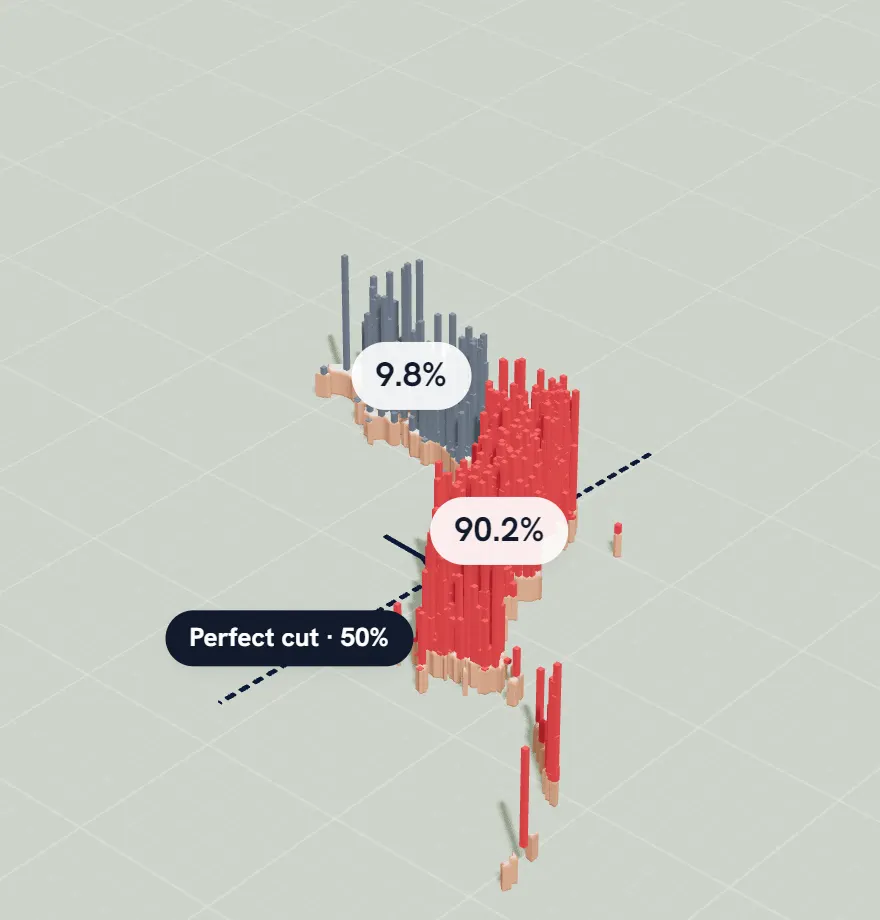
The straight-line test
Draw one straight line across Japan so that exactly half the population is on each side. Of all the lines that do it, the most lopsided puts half of everyone on the south-east side, on just 21.1% of the land.
Now cut the land in half instead, at the same angle. That looks like the fair cut, but the south-east half ends up with 77.8% of the people. Both figures are our measurements from the GHSL population grid (European Commission JRC, 2025) inside Natural Earth borders.
That gap between how a country looks and where its people are is exactly what Slice is about.
Why Japan's population is so packed together
About three-quarters of Japan is mountains, according to Japan's land ministry. People live where the land is flat: on the plains that rivers built at the foot of the mountains, along the coast. That is where rice could be grown, and it is where the cities are today.
Most of those plains line one stretch of the Pacific coast. The Taiheiyō Belt, a chain of cities about 1,200 km long from Ibaraki, north-east of Tokyo, to Fukuoka in the south-west, is home to around 80 million people: roughly two in every three people in Japan.
Greater Tokyo alone has about 37 million people. Compare Hokkaido, the big northern island: it covers about 22% of Japan's land (83,424 km²) but is home to about 5 million people, only around 4% of the country.