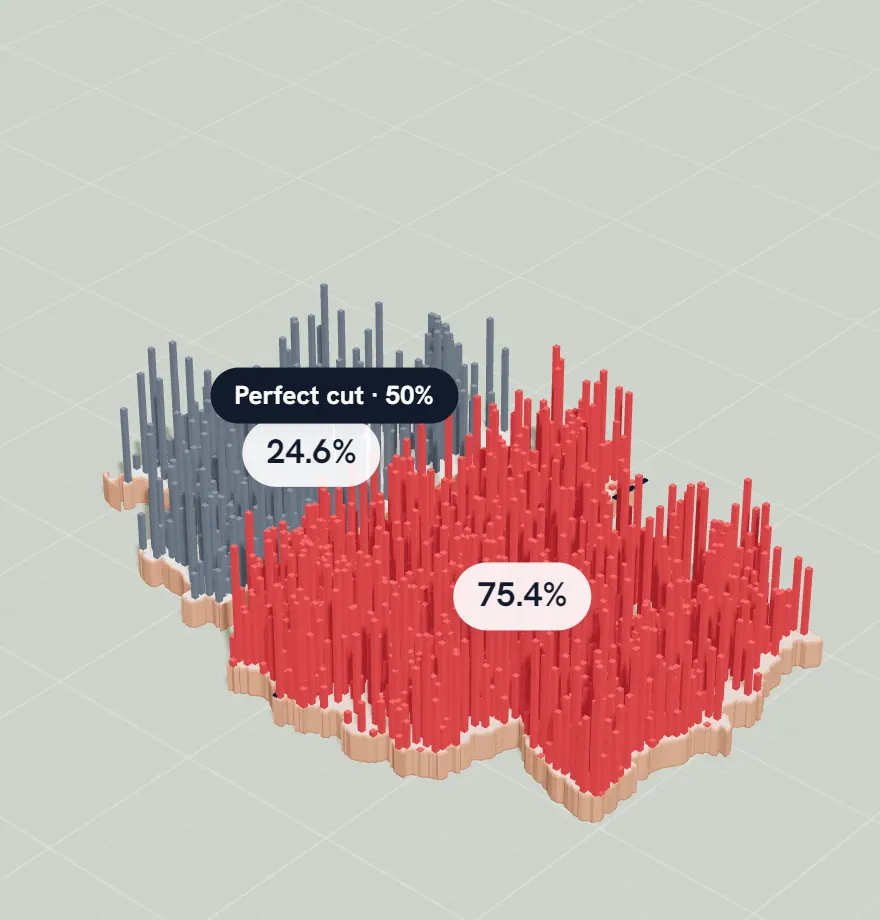
The straight-line test
Draw one straight line across Germany so that exactly half the population is on each side. Of all the lines that do it, the most lopsided puts half of everyone on the south-west side, on just 31.8% of the land.
Now cut the land in half instead, at the same angle. That looks like the fair cut, but the south-west half ends up with 64.4% of the people. Both figures are our measurements from the GHSL population grid (European Commission JRC, 2025) inside Natural Earth borders.
That gap between how a country looks and where its people are is exactly what Slice is about.
Why Germany is spread so evenly
Germany's biggest cluster of people, Rhine-Ruhr in the west, isn't one giant city. It is a region of more than 10 million people where Cologne, Düsseldorf, Dortmund, Essen and their neighbours have grown into each other: many centres, not one.
Our own measure shows how even it is. Germany's most lopsided half-cut still needs almost a third of the land: far more than Japan, Australia or South Korea, where a much smaller corner holds half of everyone.
The east has been thinning out, though: about 1.7 million people, 12% of its population, have left the former East German states since the fall of the Berlin Wall, according to official figures. Germany is home to about 83.5 million people in all, the most of any country in the European Union.